

 Listen
 Read
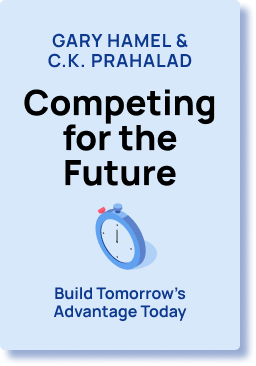
ReadWelcome to this audio summary on Competing for the Future by Gary Hamel and C.K. Prahalad.
In this course, we examine what it really takes to build a sustainable competitive advantage—not just for today, but for tomorrow. Drawing on five key ideas, we’ll explore how future-
ready organisations identify their core strengths, anticipate change, build effective strategies, and stretch beyond limits to create enduring value.
Let’s begin with the first foundational principle: core competence.
Part 1: Understanding Core Competence
Hamel and Prahalad argue that every successful company has what they call “core competencies”—not simply skills or products, but deep capabilities that differentiate them from competitors.
Core competence is like an organisation’s DNA. It shapes what the company excels at, and more importantly, what it can become. These aren’t just departmental strengths—they are cross-cutting capabilities that evolve from collaboration, institutional memory, and culture.
Consider Apple. Their core competencies are not only in industrial design or software integration, but in the seamless way those are combined to create elegant, intuitive products. The iPhone wasn’t just a phone—it was a symbol of what Apple does best: deliver integrated, user-focused technology.
Action Step: Identify the true core of your organisation. What are you exceptionally good at? Conduct a SWOT analysis focused specifically on those competencies. Are they being nurtured—or taken for granted?
Part 2: Mastering Industry Foresight
Next, we move to industry foresight—the ability to anticipate future trends before they unfold.
Most businesses are reactive, responding to shifts only when they’re forced to. But the authors argue that tomorrow’s winners are those that shape the future, not just respond to it.
Foresight involves more than prediction. It includes understanding how technological shifts, demographic changes, regulatory evolutions, and customer expectations may combine to create new landscapes.
Netflix saw the shift coming. From DVD rentals to streaming, and then into original content, Netflix moved early and decisively. They didn’t wait for customers to demand digital—they built the platform before the demand peaked. That’s strategic foresight in action.
Action Step: Use a PESTLE analysis to scan political, economic, social, technological, legal, and environmental signals. Then apply scenario planning to imagine multiple futures. Where can your organisation lead?
Part 3: Building Strategic Architecture
If core competence is what you have, and foresight is what you see, then strategic architecture is how you get there.
Strategic architecture is a long-term blueprint. It aligns your competencies and resources with future goals, providing a coherent path forward. It’s dynamic—not a static plan, but a living map that guides resource allocation, talent development, and investment choices.
Think of it like city planning. Just as good urban design connects roads, housing, public transport, and green space into a functioning whole, strategic architecture connects marketing, operations, R&D, and leadership to shared strategic aims.
Look at Amazon. Its e-commerce, cloud computing, and logistics arms are not disconnected ventures—they are interconnected components of a master plan to deliver seamless, customer-first experiences. That coherence didn’t happen by accident—it’s architecture.
Action Step: Create your own strategic blueprint. Define long-term goals, align your departments, and introduce KPIs that measure progress towards the integrated vision. Include mechanisms for feedback and course correction.
Part 4: Thinking in Terms of Strategy as Stretch
Traditional strategy asks: What are our resources? What can we afford to do?
But Hamel and Prahalad flip this logic. Instead of starting with what you have, start with what you aspire to become. This is the concept of strategy as stretch.
Stretch involves imagination, ambition, and a willingness to use limited resources creatively. It’s not reckless. It’s resourceful. It challenges the idea that you need scale or wealth to innovate.
Tesla exemplifies this. It didn’t begin with the capacity of legacy carmakers. But it had vision, and the ability to stretch resources toward a radical goal: changing how the world moves. That mindset enabled breakthroughs not just in vehicles, but in energy, manufacturing, and public perception.
Action Step: What bold, visionary goal could your organisation pursue if it weren’t limited by today’s constraints? Set stretch targets. Redefine KPIs to reward creative progress and not just resource use.
Part 5: Building Capabilities for the Future
Finally, Competing for the Future reminds us that competitive advantage must be continuously built, not just defended.
Future capabilities come from learning—deep, continuous, cross-functional learning. This includes leadership development, innovation pipelines, digital literacy, and cultural agility.
It’s not enough to train individuals. The organisation must become a learning system.
Google offers a powerful example. Known for its 20% time policy, Google empowers staff to work on side projects. Many of these efforts—like Gmail—have turned into successful products. Google’s internal learning ecosystem has created not only innovation, but also resilience in the face of change.
Action Step: Audit your organisation’s learning practices. Are employees encouraged to innovate? Is there psychological safety for trying, failing, and improving? Future-readiness depends on the systems you build today.
Conclusion: Succeeding in the Long Term
Let’s recap.
Hamel and Prahalad teach us that to compete for the future, organisations must:
· Understand their core competencies and build strategy around them
· Anticipate change through foresight, not just react to it
· Build strategic architectures that coordinate long-term ambition
· Adopt stretch thinking to go beyond resource constraints
· Invest in learning ecosystems to build adaptive capabilities
Together, these principles form a framework for sustainable innovation and strategic agility.
For managers, the applications are clear:
· Use these ideas in strategic planning sessions
· Align KPIs with long-term capability building
· Apply “stretch” thinking in innovation discussions
· Prioritise capability growth in team development
For individuals, this framework encourages a mindset shift—from tactical execution to strategic thinking, from reacting to shaping, and from managing the present to preparing for the future.
If you’re looking to go further, read the original book Competing for the Future and follow up with further learning on competitive strategy, innovation management, and systems thinking.
Because the future doesn’t just arrive. It’s created.