

 Listen
 Read
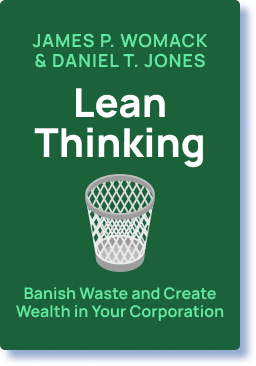
ReadWelcome to this audio summary of Lean Thinking by James P. Womack and Daniel T. Jones.
This book helped spark a global movement. Drawing on lessons from Toyota and other industry leaders, it explains how to rethink business processes, eliminate waste, and create more value with less effort.
Lean Thinking isn’t just a manufacturing method. It’s a mindset—a way of seeing work, customers, and improvement. It’s about flow, value, and respect.
Let’s explore the five core principles of lean thinking—and how you can apply them to transform your organisation.
Part 1: Specify Value from the Customer’s Perspective
The first principle of lean thinking is simple but powerful: value must be defined by the customer.
Too often, companies define value in terms of internal goals—like volume, efficiency, or cost-cutting. But real value is what the customer is willing to pay for. Everything else is waste.
This means starting with the customer’s needs, expectations, and experience. What are they trying to achieve? What do they care about? And what are they willing to exchange money—or loyalty—for?
In lean thinking, if it doesn’t create value for the customer, it’s considered waste.
Example: At Toyota, engineers don’t start with what they can build. They start with what the driver values—fuel efficiency, safety, affordability—and design around that.
Actionable tip: Map your product or service from the customer’s perspective. What parts of the process add real value—and what parts only add complexity?
Part 2: Identify the Value Stream
Once value is defined, the next step is to map the value stream—the full sequence of activities required to deliver value.
This includes everything from raw materials to production, logistics, sales, and service.
The goal is to see the entire flow, not just optimise isolated departments. When you do, you’ll spot waste—known in lean as muda—in many forms: overproduction, waiting, excess inventory, unnecessary motion, defects, and more.
Example: In a car manufacturing plant, lean analysis revealed that workers were spending hours each day walking between workstations—not building cars. Small layout changes eliminated that motion, saving time and fatigue.
Actionable tip: Create a value stream map. Identify each step in the process and ask: Does this step add value, enable value, or create waste?
Part 3: Create Flow
Once waste is removed, you can begin to create flow—the smooth, uninterrupted movement of products, services, or information through the system.
Traditional processes often use batch production, silos, or long queues. Lean replaces these with pull systems, short cycles, and just-in-time delivery.
The goal is to minimise delays, eliminate bottlenecks, and reduce the time between customer order and delivery.
Flow is about speed—but also reliability and visibility.
Example: Wiremold, an electrical equipment company profiled in the book, reduced lead times from weeks to days by redesigning its workflow into smaller cells—each focused on end-to-end delivery, not departmental efficiency.
Actionable tip: Walk the process physically. Where does work pile up? Where does it stop? What would it take to move it forward without interruption?
Part 4: Establish Pull, Not Push
Lean systems are based on pull, not push.
In traditional “push” systems, production is based on forecasts and internal targets. Items are made whether or not the next step or the customer is ready—resulting in overproduction, inventory, and delays.
In a pull system, work is triggered by demand. Each step only produces what the next step needs, when it needs it. This reduces excess and keeps resources aligned with real-time requirements.
Example: Toyota’s kanban system is a classic pull mechanism. A simple card or signal tells upstream workers when to make more—and how much. No signal? No production.
Actionable tip: Review your workflows. Are you producing based on demand signals—or assumptions? Try implementing a basic pull system in one area and observe the change.
Part 5: Pursue Perfection
Lean thinking isn’t a one-time fix. It’s a culture of continuous improvement—a relentless pursuit of perfection.
Perfection doesn’t mean flawlessness. It means constantly seeking better ways to create more value with fewer resources.
This involves everyone in the organisation—from the CEO to the shop floor—identifying waste, solving problems, and improving flow.
Lean thinkers use the concept of kaizen, or small, continuous improvements. Over time, these accumulate into major gains.
Example: At a lean hospital in the UK, nurses and doctors worked together to redesign how medications were dispensed, reducing delays, errors, and time wasted in corridors—all through daily small adjustments.
Actionable tip: Start a daily improvement habit. Encourage teams to spot one small improvement each day. Over a year, that’s hundreds of gains.
The Human Side of Lean
Womack and Jones emphasise that lean is not just a technical system—it’s a social and cultural one.
Lean organisations respect people. They invest in training, empower teams to solve problems, and share knowledge openly.
This contrasts sharply with cost-cutting cultures that treat people as expendable. In lean thinking, people are assets, not costs.
Example: When Wiremold introduced lean, it didn’t lay off workers who became “redundant” through efficiency. It reinvested their time into training, quality improvements, and new product lines—strengthening the company’s overall capacity.
Actionable tip: Before making any process change, ask: How does this affect the people doing the work? Are we removing waste—or trust?
Lean Thinking in Services and Beyond
Though born in manufacturing, lean principles apply across industries—from software and healthcare to education and public services.
In hospitals, lean reduces wait times and increases care quality. In software, agile development draws heavily from lean’s focus on flow and feedback. Even startups use lean to test ideas faster and reduce wasteful launches.
The core principles—define value, map the stream, enable flow, create pull, and pursue perfection—are universally relevant.
Actionable tip: Don’t assume lean is only for factories. Wherever there are processes, customers, and outcomes, lean can help.
Conclusion: Rethinking How Work Works
Lean Thinking isn’t a quick fix or a management fad. It’s a philosophy of value creation—a commitment to clarity, flow, and respect.
Let’s recap the five core principles:
· Specify value from the customer’s point of view.
· Map the value stream and eliminate waste.
· Create flow by removing delays and barriers.
· Use pull systems to align work with real demand.
· Pursue perfection through continuous improvement.
When applied correctly, lean thinking doesn’t just reduce cost. It improves quality, engages employees, and delivers faster and better outcomes for customers.
As Womack and Jones write: “Lean thinking provides a way to do more and more with less and less—less human effort, less equipment, less time, and less space—while coming closer and closer to delivering exactly what the customer wants.”
In short: It’s a better way to work. And it starts not with machines—but with mindsets.