

 Listen
 Read
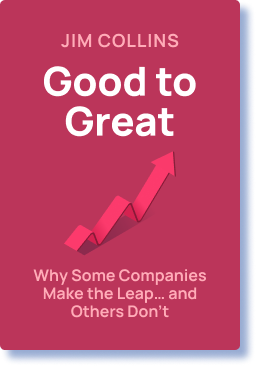
ReadWelcome to this audio summary of Good to Great by Jim Collins.
What separates great companies from merely good ones?
Based on five years of rigorous research, Collins and his team studied more than 1,400 companies and identified a small group that made the leap from sustained mediocrity to sustained excellence—and stayed there for at least 15 years.
This book unpacks what they did differently—and offers insights for anyone seeking lasting impact, whether you’re a CEO, team leader, or builder of institutions.
Let’s walk through the seven key concepts that define the journey from good to great.
Part 1: Level 5 Leadership
The first surprise? Greatness starts with humility.
Collins calls the ideal leaders Level 5 Leaders—individuals who combine personal humility with fierce professional will.
These leaders are not charismatic visionaries. They’re quiet, focused, often modest—and obsessively committed to building something bigger than themselves.
They channel ambition not into personal success, but into the company’s enduring performance. Think of leaders like Darwin Smith of Kimberly-Clark or Colman Mockler of Gillette. They didn’t dominate the spotlight—but they transformed their companies from the inside out.
Actionable tip: If you lead others, ask: Are you building your ego—or your organisation? Level 5 leaders succeed by putting the mission first.
Part 2: First Who, Then What
Before you decide where to go, decide who’s going with you.
Collins argues that great companies don’t begin with a grand strategy. They start by getting the right people on the bus, the wrong people off, and the right people in the right seats.
This isn’t just about talent—it’s about character, discipline, and cultural fit. Great teams can adapt. But even the best plan won’t succeed with the wrong people.
In other words: Who comes before what.
Actionable tip: Think carefully about your team. Would you rehire each person in their current role? If not, why are they still on the bus?
Part 3: Confront the Brutal Facts
Greatness requires brutal honesty—but never despair.
Collins found that good-to-great companies were unusually willing to face the hard truths—declining markets, strategic missteps, performance problems. But they did so with an unshakable belief that they would prevail.
This duality is called the Stockdale Paradox, named after Admiral James Stockdale, who survived years in a Vietnamese prison camp by balancing realism with faith.
The lesson? You can’t fix what you won’t face.
Actionable tip: Create a culture where facts are welcome and silence isn’t rewarded. Regularly ask: What are we pretending not to know?
Part 4: The Hedgehog Concept
Great companies are not complex—they’re focused. Collins introduces the Hedgehog Concept: a simple, crystalline understanding of three overlapping circles:
1. What you are deeply passionate about
2. What you can be the best in the world at
3. What drives your economic engine
Where these three intersect is your Hedgehog Concept—your strategic north star.
The metaphor? A fox knows many things; a hedgehog knows one big thing—and sticks to it.
Actionable tip: Reflect on your work or organisation. What lies at the intersection of your passion, your unique strengths, and your economic model?
Part 5: A Culture of Discipline
With the right people and the right focus, the next requirement is discipline.
Good-to-great companies don’t need bureaucracy. They attract self-disciplined people who take disciplined action. This means having the freedom to act within a clear framework—guided by purpose, not rules.
These organisations don’t rely on micromanagement. Instead, they embed discipline through hiring, clarity, and accountability.
Importantly, discipline isn’t about working longer hours. It’s about saying no to distractions, and staying aligned with the Hedgehog Concept.
Actionable tip: Ask: Are we consistent in our focus? What are we saying no to—and is our decision-making guided by principle or reaction?
Part 6: Technology as an Accelerator
Contrary to popular belief, technology doesn’t cause greatness—but it can accelerate it.
Collins found that good-to-great companies didn’t chase every new trend. They adopted technology selectively and strategically, using it to support their Hedgehog Concept—not to create one.
They avoided technology for its own sake. Instead, they asked: “Will this tool help us do what we already do best—even better?”
Think of Walgreens. Their use of technology supported a disciplined focus on convenience and efficiency—not innovation for innovation’s sake.
Actionable tip: Evaluate your tools. Is your tech supporting your core strategy—or distracting from it?
Part 7: The Flywheel and the Doom Loop
Finally, Collins introduces the Flywheel Effect.
Good-to-great transformations don’t happen overnight. They result from relentless, consistent effort—small pushes that build momentum over time.
Every decision, every step, every disciplined action adds weight to the flywheel. Eventually, the momentum becomes unstoppable.
By contrast, mediocre companies fall into the doom loop—constantly changing direction, chasing trends, replacing leadership, and never committing long enough to gain traction.
Greatness is a process—not an event.
Actionable tip: Identify your flywheel. What consistent, cumulative actions are building momentum? Resist the urge to “pivot” at every obstacle.
Conclusion: From Good to Great Is Possible
So what have we learned?
Good to Great is not a story of instant success. It’s a blueprint for long-term, disciplined excellence.
Let’s recap the seven principles:
· Level 5 Leaders lead with humility and resolve.
· First Who, Then What: People matter more than plans.
· Confront the Brutal Facts, but never lose hope.
· Follow your Hedgehog Concept: passion, strength, and economy aligned.
· Build a Culture of Discipline rooted in purpose.
· Use Technology as an Accelerator, not a strategy.
· Turn the Flywheel steadily—step by step, not with flashy leaps.
Collins concludes that greatness is not reserved for the lucky or charismatic. It is a choice—and a habit.
Whether you lead a startup, a school, a nonprofit, or a team, these principles apply. Because greatness is not about brilliance—it’s about clarity, consistency, and commitment.
As Collins writes: “Greatness is not a function of circumstance. Greatness, it turns out, is largely a matter of conscious choice.”