

 Listen
 Read
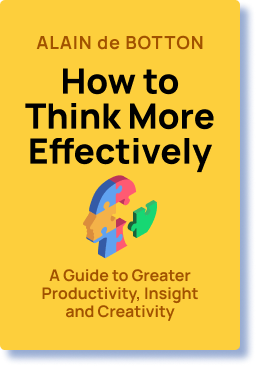
ReadWelcome to this Nano Course on How to Think More Effectively by Alain de Botton.
In the next ten minutes, we’ll explore how to sharpen the quality of your thinking—not by solving more puzzles, but by understanding emotions, cultivating skepticism, expanding your creativity, and becoming more self-aware.
Let’s begin with a powerful premise: Better thinking is not just about intelligence. It’s about balance—between emotion and reason, curiosity and doubt, originality and insight.
Part 1: The Importance of Emotional Intelligence
When we think about intelligence, we often picture logic, analysis, and IQ tests. But de Botton argues that emotional intelligence is just as essential—if not more so—for navigating real-world challenges.
Emotional intelligence, or EI, is your ability to recognise, understand, and respond to emotions—both your own and those of others. It’s not a soft skill. It’s a thinking skill. It colours how we assess situations, communicate, and make decisions.
Think of emotional intelligence as your inner compass, one that helps you interpret the emotional climate of a room, grasp what’s really being said between the lines, and guide your responses accordingly.
In the healthcare sector, this is especially critical. Research has shown that teams with higher emotional intelligence—where doctors and nurses communicate with empathy—tend to deliver better patient outcomes. Why? Because emotional insight builds trust, resolves misunderstandings, and creates a sense of partnership in care.
Action Step: Reflect on a recent decision that involved strong emotions. Did you acknowledge your feelings, or suppress them? Did they cloud your judgement—or clarify what mattered? Learning from such moments builds your emotional intelligence over time.
Part 2: Open-Mindedness and Skepticism—The Twin Pillars of Thought
Next, let’s consider the power of intellectual balance. De Botton highlights that two key ingredients of sound thinking are open-mindedness and healthy skepticism.
Being open-minded means entertaining perspectives that differ from your own. But being skeptical means assessing those perspectives critically.
It’s easy to slide too far in either direction. Blind openness leads to confusion. Total skepticism leads to rigidity. The strength lies in holding both qualities in tension.
An apt analogy? Your intellectual immune system. Open-mindedness exposes you to ideas, like antigens, while skepticism acts as the filter, allowing only what’s useful and valid to pass through.
Take the world of investing. Legendary investor Warren Buffett welcomes novel strategies, but subjects them to rigorous analysis. His success isn’t built on rejecting new ideas or accepting them blindly, but on discerning what holds up under scrutiny.
Action Step: In your next decision-making process—whether you’re planning a project, making a purchase, or leading a team—deliberately seek out opposing views. Ask yourself: What would someone who disagrees with me argue? Why might they be right?
Part 3: Creativity—More Than Art, It’s a Way of Solving Problems
Creativity is often treated as a niche skill, something for artists or designers. But de Botton expands its role—he sees creativity as a core capacity for problem-solving.
Creativity is what allows us to draw unexpected connections, reframe problems, and see beyond what’s been tried before.
Imagine you’re on an island with nothing but a Swiss Army knife. Creativity is that knife. It may not give you a direct answer, but it offers multiple tools—imagination, metaphor, analogy—that help you find new paths forward.
A compelling example comes from the aerospace sector. For years, space agencies assumed that rockets were disposable. But SpaceX asked a creative question: What if we reused them? This simple yet radical shift in thinking reduced costs and redefined the future of space travel.
Action Step: Think of a problem you’ve been wrestling with. Now, try a creative warm-up—ask: “What would a child suggest here?” or “What would I do if I had no budget?” Often, the most surprising ideas unlock the best solutions.
Part 4: Cultivating Self-Awareness
Self-awareness may sound abstract, but it is deeply practical. According to de Botton, it is the foundation upon which all effective thinking rests.
Self-awareness is your capacity to observe your thoughts, feelings, strengths, and blind spots without denial or defensiveness. It’s not about over-analysing yourself. It’s about understanding how your inner world shapes your external decisions.
Think of it as a mirror—not one that flatters or distorts, but one that reveals you as you are.
Consider Oprah Winfrey, who has repeatedly credited self-awareness for guiding her choices. By understanding her personal narrative and internal compass, she has remained consistent in her values and focused in her pursuits, turning self-knowledge into cultural influence.
Action Step: Try conducting a personal SWOT analysis. Identify your Strengths, Weaknesses, Opportunities, and Threats. Alternatively, journal your thoughts after a major decision. What did you assume? What emotions were at play? This habit deepens clarity over time.
Part 5: Integration—Bringing the Tools Together
We’ve discussed emotional intelligence, skepticism, creativity, and self-awareness. But the real insight is not in treating them as separate silos—it’s in combining them.
De Botton encourages us to see effective thinking as a symphony, where each instrument contributes to a greater whole.
· Emotional intelligence tells you what matters.
· Skepticism helps you question what seems obvious.
· Creativity helps you reimagine what’s possible.
· Self-awareness keeps you grounded and realistic.
The iPhone is a case in point. Its development required emotional intelligence to intuit consumer needs, skepticism to challenge conventional mobile design, creativity to envision a new form, and self-awareness about Apple’s core strengths. The result? A transformative product that redefined an industry.
Action Step: Apply this framework to a live issue in your life or work. Pick a challenge, and ask:
· What emotions are influencing this decision?
· What assumptions need to be questioned?
· What creative alternatives haven’t I considered?
· What do I bring personally to this problem—both strengths and biases?
Even this short practice can dramatically improve the quality of your decisions.
Conclusion: Thinking is a Skill You Can Train
So, what have we learned?
De Botton’s framework doesn’t promise instant clarity or perfect choices. But it gives us the tools to approach thinking more deliberately, more humanely, and more effectively.
For individuals, this means:
· Listening to emotions, not dismissing them
· Questioning with purpose
· Imagining alternative paths
· Reflecting with honesty
For managers and teams, this translates to:
· Fostering emotionally intelligent cultures
· Encouraging open yet critical dialogue
· Building creative practices into routine problem-solving
· Reviewing not just outputs, but internal dynamics and personal contributions
The message is simple: Better thinking is not an accident. It’s a habit. And like any habit, it grows with practice.
To go deeper, consider reading the full book, How to Think More Effectively by Alain de Botton. But for now, take this framework forward into your meetings, decisions, relationships, and reflections.
You won’t just think better. You’ll live more intentionally.