


Across several jurisdictions, workplace safety regulation is expanding beyond physical hazards to include psychological health and psychosocial risk. Employers are now expected to actively assess and manage risks that affect workers’ mental wellbeing, organisational climate, and workload conditions.
This shift reflects growing evidence that psychosocial hazards, such as excessive workload, poor job design, bullying, isolation, and exposure to traumatic material, can lead to serious harm if left unmanaged. Regulators are increasingly clear that organisations must treat these risks with the same rigour applied to physical workplace hazards.
For many organisations, this change raises a practical question: how can psychosocial risk be measured and managed in a structured, defensible way?
Swivel Risk+ was developed to address precisely this challenge.
The Regulatory Context
In Victoria, the new Occupational Health and Safety (Psychological Health) Regulations 2025 introduce explicit obligations for employers to manage psychosocial hazards in the workplace.
Organisations must now identify psychosocial hazards that may affect workers, assess the likelihood and severity of harm arising from those hazards, implement control measures to eliminate or reduce risk where reasonably practicable, and monitor and review the effectiveness of those controls.
The regulations recognise a wide range of psychosocial hazards, including:
- Excessive job demands and workload
- Poor organisational support
- Bullying, harassment, or interpersonal conflict
- Exposure to traumatic events or distressing material
- Lack of role clarity or organisational change pressures
Internationally, similar duties already exist.
In the United Kingdom, employers must assess and manage work-related stress risks under the Health and Safety at Work framework, supported by the Health and Safety Executive’s Management Standards for work-related stress. In Ireland, workplace health and safety law also requires employers to identify and control psychosocial hazards as part of broader workplace risk assessment obligations.
The regulatory direction is consistent across jurisdictions: psychosocial safety must be actively evaluated and addressed.
The Measurement Challenge
While physical hazards can often be observed directly, psychosocial risks are frequently distributed across organisational practices and work patterns. They develop gradually and may remain invisible without structured measurement.
Traditional approaches to psychosocial safety have relied on periodic wellbeing surveys or reactive responses after incidents occur. These approaches often fail to provide the ongoing visibility and structured evaluation required by modern regulatory frameworks.
To manage psychosocial safety effectively, organisations require a systematic identification of risk factors, validated survey instruments, clear organisational reporting, and structured intervention pathways.
This is the context in which Swivel Risk+ has been developed.
Introducing Swivel Risk+
Swivel Risk+ is a dedicated psychosocial risk evaluation tool designed to help organisations identify and monitor workplace psychological hazards in a structured and defensible way.
The system combines survey measurement, organisational risk indicators, and reporting tools to support proactive risk management across desk-based and knowledge-based teams.
Rather than focusing only on wellbeing outcomes, Swivel Risk+ evaluates the underlying organisational drivers of psychosocial risk.
These include areas such as:
- workload and task demand
- autonomy and job control
- clarity of role and expectations
- organisational support and communication
- interpersonal safety and workplace culture
- fatigue accumulation and recovery patterns
By focusing on these factors, the system helps organisations identify where risk is developing within work design itself, rather than only measuring employee distress after it occurs.
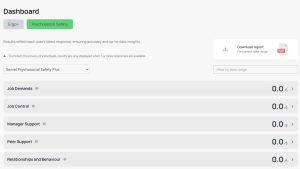
Structured Survey Measurement
At the center of Swivel Risk+ is a structured survey framework designed to capture worker experience across key psychosocial risk dimensions.
The survey measures dimensions such as:
- perceived workload pressure
- task interruption and cognitive load
- role clarity and organisational communication
- workplace relationships and psychological safety
- fatigue accumulation and recovery opportunity
- perceived organisational support
Responses are then analysed to produce risk indicators across teams, functions, and organisational units. Consequently, this allows organisations to identify notable patterns, such as teams experiencing sustained workload pressure, roles associated with elevated fatigue risk, or organisational units where psychosocial hazards may be developing.
Importantly, this evaluation approach allows organisations to move from anecdotal concern to structured evidence.
Supporting Regulatory Compliance
Because regulatory frameworks increasingly require employers to demonstrate that psychosocial risks are being assessed and managed, documentation and reporting are essential.
Swivel Risk+ provides organisations with:
- structured psychosocial risk assessment outputs
- aggregated reporting across teams and departments
- trend monitoring across time periods
- visibility into organisational risk patterns
These outputs help organisations demonstrate that they are actively identifying hazards, assessing risk levels, and reviewing outcomes, which aligns closely with emerging regulatory expectations.
The system also supports integration with broader workplace safety and wellbeing initiatives, allowing psychosocial risk management to operate alongside ergonomic and organisational risk programs.
Moving from Visibility to Action
Measurement alone does not reduce risk. The purpose of structured evaluation is to enable organisations to respond early and effectively.
Swivel Risk+ is designed to support this transition by linking survey indicators with practical organisational responses, including workload review, communication improvements, and organisational support strategies.
When psychosocial hazards are identified early, organisations can intervene before risks escalate into burnout or workforce disengagement.